History of Gilgit-Baltistan: From Ancient Civilizations to Modern Times
Discover the fascinating history of Gilgit-Baltistan, from ancient Silk Road trade routes and Buddhist heritage to local mountain kingdoms, Dogra and British rule, the events of 1947, and the region's modern political development. Explore the historical cultures, forts, archaeological sites, and traditions that have shaped this remarkable region of northern Pakistan.
History of Gilgit-Baltistan: From Ancient Civilizations to Modern Times
Gilgit-Baltistan is a mountainous region in northern Pakistan with a history shaped by ancient civilizations, Silk Road trade, Buddhist heritage, local kingdoms, Islamic traditions, and major political changes. Located at the crossroads of the Karakoram, Himalayas, and Hindu Kush, the region historically connected South Asia with Central Asia and China.
Today, Gilgit-Baltistan is famous for its spectacular mountains, valleys, glaciers, lakes, forts, and rich cultural heritage. However, behind its natural beauty lies a history that stretches back thousands of years.
Ancient History of Gilgit-Baltistan
The history of Gilgit-Baltistan goes back to ancient times. The region's location along important mountain routes made it a meeting point for travelers, traders, pilgrims, and different civilizations.
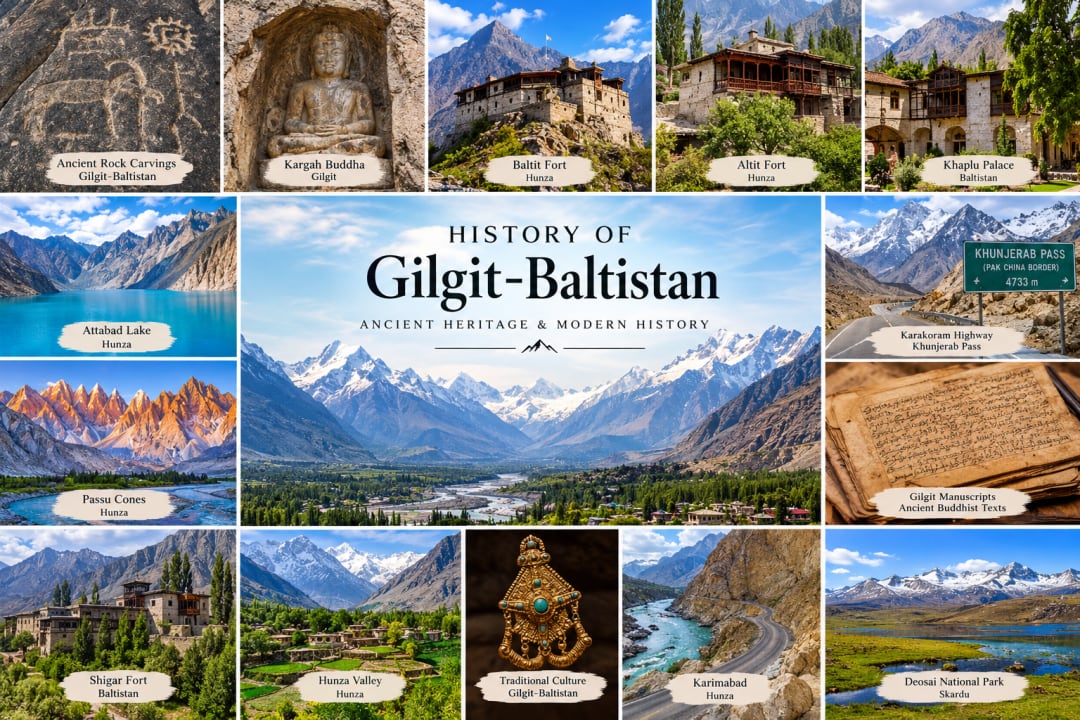
Ancient rock carvings and inscriptions found throughout the region provide evidence of centuries of human activity. Many of these archaeological remains are located along routes that later became associated with the Silk Road.
The rock art found in areas around Gilgit, Hunza, Diamer, and other valleys includes images, symbols, and inscriptions left by travelers and local communities.
These archaeological remains help historians understand the cultural and commercial importance of the region in earlier periods.
Gilgit-Baltistan and the Ancient Silk Road
One of the most important features of Gilgit-Baltistan's history is its connection with the ancient Silk Road.
The region was positioned between Central Asia, China, Kashmir, and the Indian subcontinent. Mountain passes and valleys provided routes through which traders and travelers moved between different parts of Asia.
Trade routes brought more than goods. Languages, artistic traditions, religions, technologies, and cultural ideas also traveled through these mountain valleys.
Because of this location, Gilgit-Baltistan became an important center of cultural exchange.
Buddhist Heritage in Gilgit-Baltistan
Buddhism played an important role in the history of the region, particularly during the first millennium CE.
Archaeological discoveries, manuscripts, rock carvings, stupas, and other remains demonstrate the importance of Buddhist culture in ancient Gilgit and surrounding areas.
The famous Kargah Buddha near Gilgit is one of the region's best-known archaeological sites. The rock carving and nearby archaeological remains are evidence of the area's Buddhist heritage.
The Gilgit manuscripts, ancient Buddhist texts written on birch bark, are also important historical discoveries associated with the region.
The archaeological record shows that Gilgit-Baltistan was connected to wider Buddhist networks extending across South and Central Asia.
Ancient and Medieval Local Kingdoms
For much of its history, Gilgit-Baltistan was not governed as one unified political territory. Different valleys and areas were controlled by local rulers, kingdoms, and principalities.
Important historical areas included Gilgit, Hunza, Nagar, Baltistan, Yasin, Punial, Gupis, and surrounding valleys.
These local states developed their own political systems, languages, traditions, and relationships with neighboring regions.
History of Hunza
Hunza developed as an important mountain kingdom in the Karakoram. The traditional rulers of Hunza were known as the Mirs.
The kingdom's location made it strategically important because routes connecting the region with Central Asia and China passed through or near Hunza.
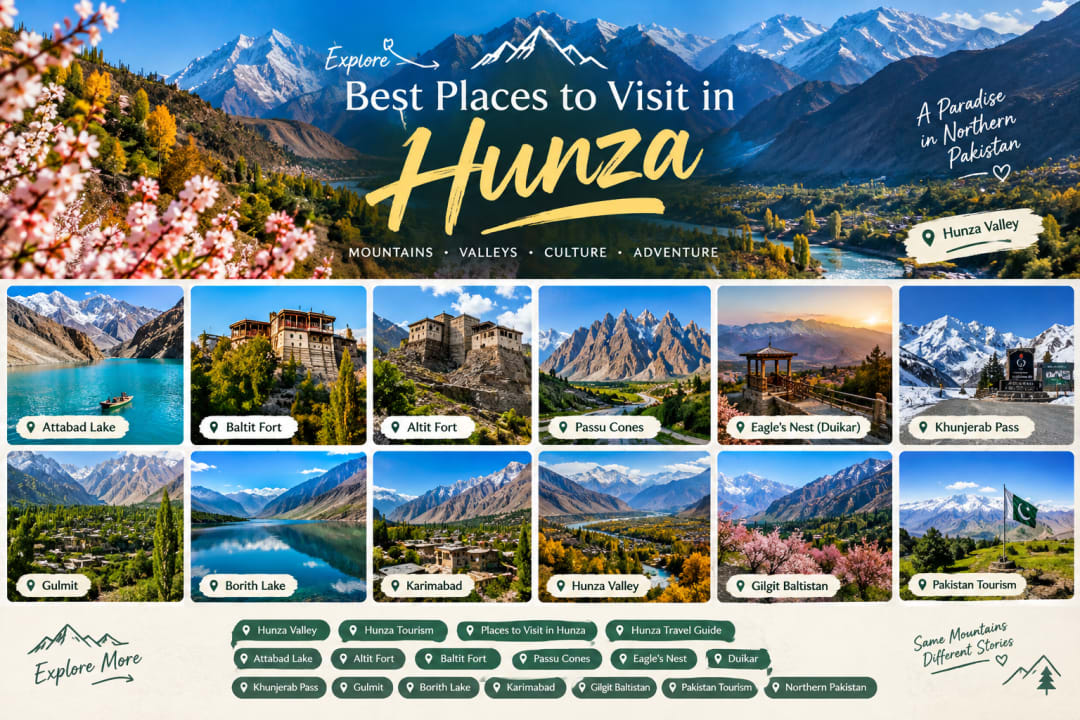
Historic buildings such as Baltit Fort and Altit Fort represent the political and architectural heritage of the former Hunza kingdom.
History of Nagar
Nagar, located opposite Hunza across the Hunza River, was another important historical state.
Hunza and Nagar maintained close cultural connections but also experienced periods of political rivalry. Their history is an important part of the development of the central Karakoram region.
History of Baltistan
Baltistan has a distinctive history influenced by Tibetan, Ladakhi, Kashmiri, Central Asian, and local traditions.
The region was historically divided into several local territories and developed strong cultural connections with neighboring areas.
Over time, Islam became an important part of Balti society, while local languages, architecture, music, food, and traditions continued to preserve the region's unique identity.
Historic sites such as Shigar Fort and Khaplu Palace reflect the royal and cultural heritage of Baltistan.
The Spread of Islam
Islam gradually became the dominant religion across Gilgit-Baltistan.
The spread of Islam took place over centuries through religious scholars, travelers, trade connections, and interaction with neighboring Muslim regions.
Islamic traditions eventually became deeply integrated with the local cultures of Gilgit, Hunza, Nagar, Baltistan, Ghizer, and other areas.
Today, Gilgit-Baltistan remains culturally diverse, with different communities preserving their own languages, traditions, and religious practices.
Dogra Rule and Political Changes
The nineteenth century brought major political changes to the region.
The Dogra rulers of Jammu and Kashmir expanded their influence into the northern mountain areas. Gilgit and other territories became connected to the princely state of Jammu and Kashmir.
The period saw military campaigns, changes in local administration, and competition for control of strategically important mountain territories.
The political history of the area during this period was also influenced by the wider competition between British India, the princely state of Jammu and Kashmir, and neighboring powers.
The Gilgit Agency and the British Era
The British became increasingly interested in the northern areas because of their strategic location near Central Asia, China, Afghanistan, and the Russian Empire.
The Gilgit Agency was established during the late nineteenth century as part of British efforts to manage the strategically important frontier.
Gilgit became an important center for political and administrative activities in the northern region.
The area was also connected to the wider geopolitical competition often known as the "Great Game."
This period left an important mark on the political and administrative history of Gilgit-Baltistan.
Gilgit-Baltistan in 1947
The year 1947 was a major turning point in the history of the region.
When British rule in the Indian subcontinent ended, the princely state of Jammu and Kashmir became the subject of a major political and military dispute between India and Pakistan.
In Gilgit, local forces and the Gilgit Scouts took control of the administration in November 1947. A provisional administration was established, and Pakistani officials subsequently took over the administration of Gilgit.
The events of 1947 became part of the larger Kashmir conflict, and the political status of the wider region remains connected to that unresolved dispute.
Development of the Northern Areas
After 1947, the areas administered by Pakistan went through several administrative changes.
The northern territories were commonly known as the Northern Areas for several decades.
In 1970, an Advisory Council for the Northern Areas was established. Further administrative and political reforms followed, including the Northern Areas Council Legal Framework Order of 1975.
These reforms gradually changed the administrative structure of the region.
Gilgit-Baltistan Self-Governance Order 2009
A major administrative development occurred in 2009.
The Government of Pakistan introduced the Gilgit-Baltistan Empowerment and Self-Governance Order, 2009. The reforms provided greater political and administrative powers and established an elected legislative assembly.
The region is now officially known as Gilgit-Baltistan and has its own elected assembly and government institutions.
The Karakoram Highway
The construction of the Karakoram Highway was another major development in the modern history of Gilgit-Baltistan.
The highway connects Pakistan with China through the Khunjerab Pass and significantly improved transportation and communication between the region and other parts of Pakistan.
The road also helped increase tourism, trade, education, and economic opportunities.
Today, the Karakoram Highway is not only an important transport route but also one of the most famous travel routes in the region.
Historical Forts and Heritage Sites
The history of Gilgit-Baltistan can still be seen in its historic buildings and archaeological sites.
Some important heritage attractions include:
- Baltit Fort in Hunza
- Altit Fort in Hunza
- Shigar Fort in Baltistan
- Khaplu Palace
- Kargah Buddha near Gilgit
- Ancient rock carvings along the Karakoram routes
- Historic mosques and traditional settlements
- Archaeological remains in different valleys
These places provide visitors with an opportunity to learn about the region's rulers, communities, architecture, and cultural traditions.
Gilgit-Baltistan Today
Today, Gilgit-Baltistan is known internationally for its mountains, cultural diversity, and adventure tourism.
The region is home to some of the world's highest peaks and includes famous destinations such as Hunza, Skardu, Nagar, Ghizer, Astore, Diamer, Shigar, Khaplu, and Deosai.
Tourism has become increasingly important to the regional economy. Visitors come to explore mountain valleys, lakes, glaciers, historic forts, trekking routes, and cultural heritage.
At the same time, local communities continue to preserve traditional languages, music, crafts, festivals, food, architecture, and customs.
Conclusion
The history of Gilgit-Baltistan is a story of cultural exchange, ancient trade, mountain kingdoms, religious transformation, political change, and modern development.
From the ancient Silk Road and Buddhist heritage to the kingdoms of Hunza, Nagar, and Baltistan, the region has been influenced by many civilizations and cultures.
Its historic forts, archaeological sites, rock carvings, traditional villages, and ancient routes continue to tell the story of its past.
Understanding the history of Gilgit-Baltistan makes a visit to the region even more meaningful. Behind every valley, fort, mountain pass, and ancient settlement is a story that connects the region to the wider history of South and Central Asia.